Overview
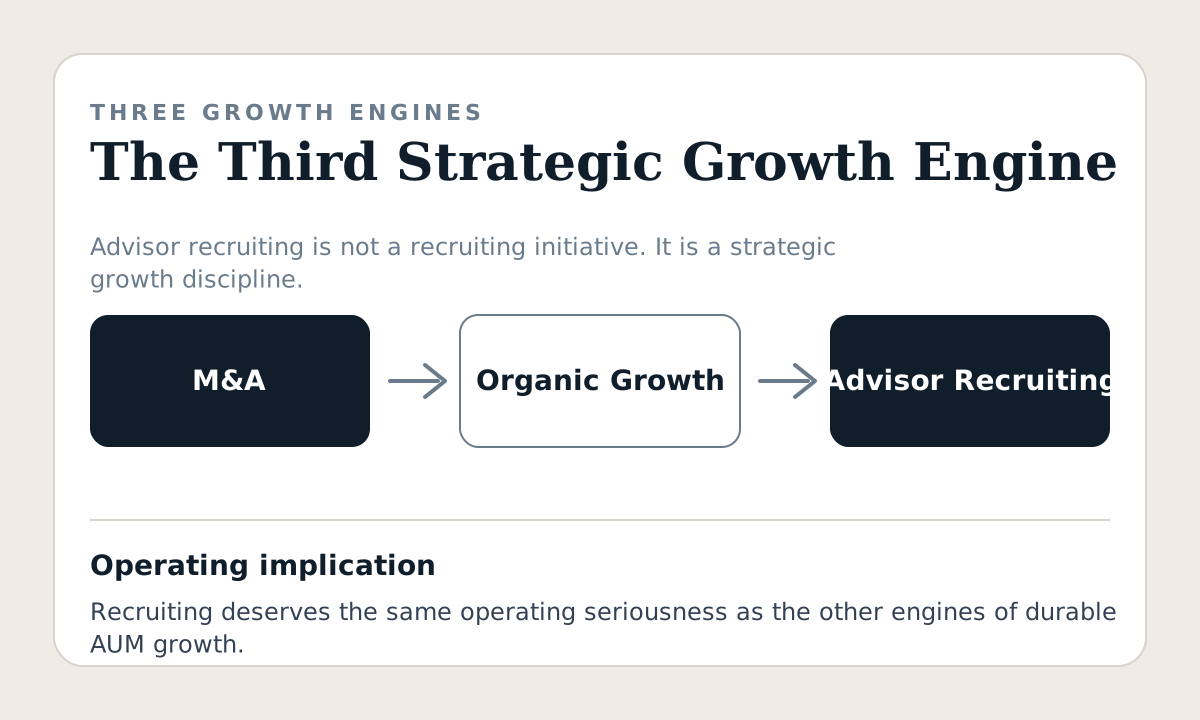
Wealth management firms have three strategic growth engines: M&A, organic growth, and advisor recruiting. All three compete for the same objective: long-term AUM growth.
Core idea
Advisor recruiting is not a recruiting initiative. It is a strategic growth discipline.
Memorable language
- Advisor recruiting is not a talent acquisition function. It is a strategic growth function.
- Most firms have mature operating systems for acquiring assets and gathering assets. Many still manage recruiting with spreadsheets, disconnected systems, and individual heroics.
The Three-Engine Growth Model
Engine one acquires assets through M&A. Engine two gathers assets through organic growth. Engine three attracts assets by winning advisor relationships. The mistake is treating the third engine as a staffing function when it competes for the same enterprise outcome as the first two.
The hidden imbalance
Most executive teams would never run M&A from a spreadsheet owned by one person, with diligence history scattered across inboxes, valuation notes trapped in memory, and no consistent way to understand why a deal advanced or died. Yet many firms tolerate exactly that pattern in advisor recruiting.
The imbalance is not usually intentional. Recruiting grew up as a relationship craft, and the craft still matters. The problem is that the craft became a substitute for institutional design. Firms professionalized acquisition and organic growth while allowing advisor recruiting to remain dependent on heroic individual execution.
That gap matters because advisor recruiting is not a soft function on the edge of the business. It is one of the few activities that can change the firm's AUM trajectory, market density, client segment, platform credibility, and local leadership reputation in a single move.
Where executives misclassify the work
The misclassification begins with language. When advisor recruiting is called talent acquisition, the organization unconsciously manages it like hiring. Hiring fills roles. Advisor recruiting builds enterprise value by attracting revenue-bearing businesses, client relationships, and market credibility.
That difference changes the operating standard. A candidate pipeline and an advisor recruiting pipeline are not the same thing. An advisor relationship may require years of context, a careful read on timing, platform fit, transition risk, spouse or partner concerns, client experience questions, and confidence that the receiving firm can actually deliver.
Executives already know how to think this way in M&A. They ask about strategic fit, integration risk, valuation, culture, operational readiness, and post-close value creation. Advisor recruiting needs a comparable level of seriousness, translated for a relationship-led market.
The operator test
The operator test is simple: can the firm explain, at any point in time, which advisor relationships matter most, why they matter now, what the next credible action should be, and how that action connects to the firm's growth strategy?
If the answer depends on asking the right recruiter in the hallway, the firm does not have a strategic recruiting operating model. It has individual knowledge. Individual knowledge is valuable, but it is fragile. It leaves when people leave, it weakens when priorities shift, and it becomes inconsistent when different regions interpret strategy differently.
The third growth engine becomes real only when recruiting strategy is visible, teachable, measurable, and repeatable without stripping away human judgment.
What mature firms do differently
Mature recruiting firms do not chase every large advisor with the same intensity. They define the kind of growth they want. They know which markets matter. They understand which advisor profiles fit their platform and which ones create cultural or transition risk. They treat timing as a strategic variable, not a lucky break.
They also create continuity. A relationship does not restart every time a recruiter changes seats. A manager can see what has been learned. Leadership can understand whether a priority is being executed or merely discussed. The system preserves why a relationship matters, not just that someone made contact.
That is the leap from recruiting as activity to recruiting as growth infrastructure.
Where this breaks in the real organization
The common failure mode is underinvestment disguised as respect for relationship craft. Leaders say recruiting is relationship-driven, which is true, and then use that truth to avoid building the operating model around the relationship. The recruiter carries too much memory, the manager sees too little context, and executives receive activity summaries instead of strategic intelligence.
The break usually shows up as normal-looking behavior. Recruiters are active. Managers are reviewing pipelines. Leaders are discussing growth. The problem is that the organization cannot prove the activity is preserving the strategy, improving judgment, or compounding knowledge.
This is why The Third Strategic Growth Engine is not merely a phrase. It is a diagnostic lens. It helps executives see the operating problem underneath familiar recruiting symptoms.
How executives should use this
An executive team should use this framework during annual growth planning. Place M&A, organic growth, and advisor recruiting on the same page. Ask what each engine is expected to contribute, what operating infrastructure each receives, and where recruiting is being asked to create strategic value without strategic support. The gaps become obvious quickly.
The goal is not to create another meeting artifact. The goal is to change what the organization pays attention to. A useful framework changes the questions leaders ask, the evidence managers inspect, and the standards recruiters use before they act.
When used well, this framework should make HNTR AI feel like the natural software expression of a deeper operating philosophy: recruiting strategy should become visible, executable, measurable, and continuously improving.
The boardroom test
The boardroom test is whether a senior team can use this framework to change resource allocation, operating cadence, and management behavior. If the framework only produces agreement, it is not finished. It has to sharpen decisions: what to fund, what to measure, what to stop tolerating, and what the organization must remember.
For The Third Strategic Growth Engine, the test is whether leaders can move from an appealing idea to an accountable operating standard. The firm should be able to say how the framework changes recruiting priorities, manager inspection, recruiter preparation, technology requirements, and the way outcomes are reviewed. If it cannot, the idea has not yet become operational.
What changes after adoption
After adoption, the conversation should sound different. Leaders should stop accepting vague pipeline updates when the real question is execution quality. Managers should stop treating stale context as a personal inconvenience and start treating it as organizational risk. Recruiters should not have to rebuild the case for every important relationship from memory.
The framework should also change technology requirements. The firm should not ask only whether a system stores data or produces activity reports. It should ask whether the system preserves context, improves judgment, coordinates the next action, and helps the organization learn from what happened.
The operating standard is not clever language, but a better way to run advisor recruiting. If an executive reads the framework and cannot identify one operating assumption worth changing, the framework has not done enough work. The idea should leave the room with a management consequence, a clearer standard for leadership behavior, and a practical next question for the team to answer in its next operating review.
Field notes
- When a firm says recruiting is a top priority but cannot name the operating cadence behind it, recruiting is still a slogan.
- AUM growth through advisor movement is too valuable to be managed as an informal side system.
- The strongest recruiters become even more valuable when the organization around them preserves context and removes avoidable friction.
Why it matters
Most firms manage M&A and organic growth with executive ownership, planning, capital, technology, measurement, and accountability. Advisor recruiting often receives less operational investment even though it can create the same enterprise value.
Common misconceptions
- That advisor recruiting is mainly a talent acquisition function.
- That a strong recruiter can compensate for weak organizational infrastructure.
- That more names in a pipeline equal a strategic growth system.
Practical implications
- Recruiting should be reviewed as a growth function, not a disconnected activity stream.
- Leadership priorities should translate into markets, cohorts, timing signals, fit criteria, and next actions.
- Technology should help firms manage recruiting with the same seriousness they bring to M&A and organic growth.
Questions executives should ask
- Who owns advisor recruiting as an enterprise growth engine?
- Does our operating model match the value of the advisors we are trying to recruit?
- Can we explain how our recruiting strategy becomes consistent execution in the field?