Overview
A Recruiting Operating System should preserve memory, coordinate execution, improve prioritization, translate strategy, measure execution quality, and continuously learn.
Core idea
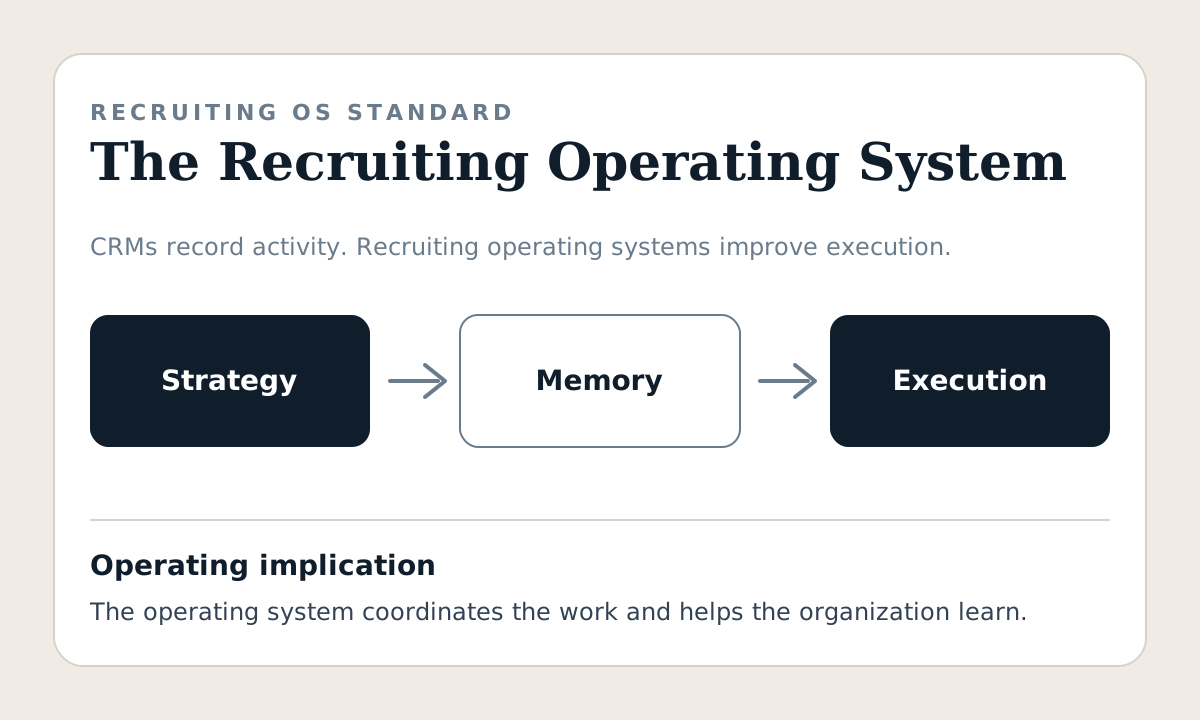
CRMs record activity. Recruiting operating systems improve execution.
The Recruiting OS Standard
A Recruiting Operating System must translate strategy, preserve memory, coordinate execution, improve prioritization, measure execution quality, and learn from outcomes.
Why CRM is the wrong category
CRM is an important category, but it is not the right category for the future of advisor recruiting. CRMs document activity. They store contacts, notes, tasks, and stages. That is useful, but it does not solve the strategic problem.
The strategic problem is execution quality. Is the right relationship being prioritized? Is the timing credible? Is the context preserved? Does the next action reflect the strategy? Does the organization learn from what happened?
A CRM can tell a manager that an activity occurred. A Recruiting Operating System should help the manager understand whether the work improved execution.
The six jobs of the system
A Recruiting Operating System has six jobs. It translates strategy into executable priorities. It preserves memory across people and time. It coordinates action so work does not fragment. It improves prioritization by combining fit, timing, and context. It measures execution quality, not just activity. It learns from outcomes.
If a system cannot do those jobs, it may be useful, but it is not the operating system for recruiting. It is a database, a workflow tool, a research tool, or a communication layer.
The category matters because categories set expectations. Advisor recruiting needs expectations high enough for the value at stake.
How HNTR AI fits
HNTR AI should not be understood as the origin of these ideas. The ideas come from the operating reality of wealth management recruiting. HNTR AI is the software implementation of the philosophy.
That distinction matters. If the product becomes the story, the ideas shrink. If the ideas remain the story, the product has a stronger foundation. The software exists because advisor recruiting needs an operating model equal to its strategic importance.
This is why the Recruiting Operating System is a category argument before it is a product argument.
What executives should demand
Executives should demand more than cleaner notes or better-looking dashboards. They should demand evidence that the system improves how the organization recruits.
Can it show where strategy is becoming execution? Can it preserve context after turnover? Can it explain why a relationship matters now? Can it help managers coach from evidence? Can it help leadership learn from outcomes?
Those are the questions that separate recording work from improving work.
Where this breaks in the real organization
The failure mode is buying another system of record and expecting it to become a system of execution. A better database can still leave strategy untranslated, memory fragmented, prioritization subjective, and learning anecdotal. Recording the work is not the same as improving the work.
The break usually shows up as normal-looking behavior. Recruiters are active. Managers are reviewing pipelines. Leaders are discussing growth. The problem is that the organization cannot prove the activity is preserving the strategy, improving judgment, or compounding knowledge.
This is why The Recruiting Operating System is not merely a phrase. It is a diagnostic lens. It helps executives see the operating problem underneath familiar recruiting symptoms.
How executives should use this
Executives should use this framework when defining the category they actually need. If the problem is lost context, uneven execution, weak prioritization, poor timing, and limited learning, the requirement is not simply CRM hygiene. The requirement is an operating system for recruiting judgment and execution.
The goal is not to create another meeting artifact. The goal is to change what the organization pays attention to. A useful framework changes the questions leaders ask, the evidence managers inspect, and the standards recruiters use before they act.
When used well, this framework should make HNTR AI feel like the natural software expression of a deeper operating philosophy: recruiting strategy should become visible, executable, measurable, and continuously improving.
The boardroom test
The boardroom test is whether a senior team can use this framework to change resource allocation, operating cadence, and management behavior. If the framework only produces agreement, it is not finished. It has to sharpen decisions: what to fund, what to measure, what to stop tolerating, and what the organization must remember.
For The Recruiting Operating System, the test is whether leaders can move from an appealing idea to an accountable operating standard. The firm should be able to say how the framework changes recruiting priorities, manager inspection, recruiter preparation, technology requirements, and the way outcomes are reviewed. If it cannot, the idea has not yet become operational.
What changes after adoption
After adoption, the conversation should sound different. Leaders should stop accepting vague pipeline updates when the real question is execution quality. Managers should stop treating stale context as a personal inconvenience and start treating it as organizational risk. Recruiters should not have to rebuild the case for every important relationship from memory.
The framework should also change technology requirements. The firm should not ask only whether a system stores data or produces activity reports. It should ask whether the system preserves context, improves judgment, coordinates the next action, and helps the organization learn from what happened.
The operating standard is not clever language, but a better way to run advisor recruiting. If an executive reads the framework and cannot identify one operating assumption worth changing, the framework has not done enough work. The idea should leave the room with a management consequence, a clearer standard for leadership behavior, and a practical next question for the team to answer in its next operating review.
Field notes
- A database can hold recruiting information without improving recruiting.
- The operating system is the place where strategy, memory, judgment, and execution meet.
- HNTR AI is strongest when it is framed as implementation of a philosophy, not as a pile of features.
Why it matters
CRMs are valuable, but activity documentation is not the same as operational intelligence. Recruiting needs systems that make strategy executable and judgment better over time.
Common misconceptions
- That a CRM is enough because it stores contacts and notes.
- That dashboards alone create execution discipline.
- That AI is the category instead of the enabling layer.
Practical implications
- The operating model comes first; software implements it.
- HNTR AI should be understood as an implementation of a broader recruiting operating philosophy.
- The system should help teams learn from outcomes, not simply track completed tasks.
Questions executives should ask
- Does our system improve execution or simply record it?
- Can it preserve memory, coordinate work, and measure quality?
- Does it make the strategy easier to execute consistently?