Overview
Great recruiting organizations outperform because they consistently make better decisions: better prioritization, preparation, context, timing, follow-up, and consistency. Relationships remain human. Judgment becomes better.
Core idea
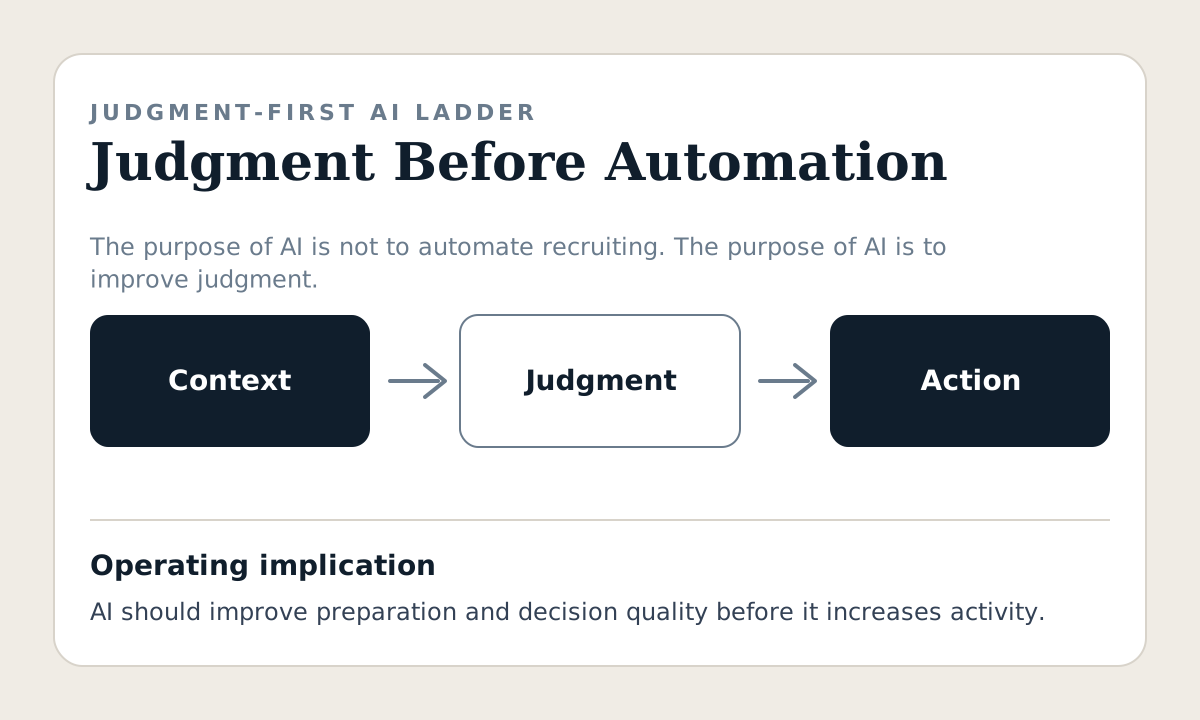
The purpose of AI is not to automate recruiting. The purpose of AI is to improve judgment.
The Judgment-First AI Ladder
Prioritize better. Prepare better. Understand context better. Time the action better. Follow up better. Only then automate anything.
The wrong AI question
The first question should not be, 'What can AI automate?' In advisor recruiting, that question points teams toward more emails, more sequences, more synthetic personalization, and more activity that can still miss the relationship.
The better question is, 'Where does the team need better judgment?' That leads to prioritization, preparation, context, timing, follow-up, and consistency.
Automation without judgment accelerates mediocrity. Judgment before automation improves the work itself.
Why relationships still own the center
Advisor recruiting is a trust market. Advisors are evaluating not only a firm but the credibility of the person initiating the conversation. They can tell when outreach is generic. They can also tell when someone has done the work.
AI should help the recruiter do the work. It should surface context, organize signals, identify fit, prepare thoughtful questions, and preserve what was learned. It should not pretend the relationship can be delegated to a machine.
The human remains accountable for judgment, trust, and timing.
The standard for responsible AI
Responsible AI in recruiting should expose uncertainty. It should show why a recommendation exists, what evidence supports it, and where human review matters. It should avoid inventing intent from weak signals.
In regulated industries, confidence without grounding is dangerous. A polished recommendation can still be wrong. A useful recommendation gives the recruiter enough context to decide whether action is appropriate.
The best AI systems will feel less like automatic send buttons and more like experienced preparation partners.
What improves when judgment improves
Better judgment changes the whole recruiting motion. The team spends less time on low-fit names. Outreach becomes more specific. Follow-up reflects what was already learned. Managers coach from evidence. Leadership sees whether the strategy is becoming execution.
That is why judgment belongs before automation. The objective is not to make recruiting less human. The objective is to make the human work more precise, more prepared, and more consistent.
Technology should earn the right to automate by first proving it can improve judgment.
Where this breaks in the real organization
The failure mode is using AI to scale weak judgment. More automated outreach can create the appearance of sophistication while lowering the quality of the relationship. In advisor recruiting, generic volume is not neutral. It can actively reduce credibility with the exact advisors a firm most wants to win.
The break usually shows up as normal-looking behavior. Recruiters are active. Managers are reviewing pipelines. Leaders are discussing growth. The problem is that the organization cannot prove the activity is preserving the strategy, improving judgment, or compounding knowledge.
This is why Judgment Before Automation is not merely a phrase. It is a diagnostic lens. It helps executives see the operating problem underneath familiar recruiting symptoms.
How executives should use this
Leadership should use this framework when evaluating AI tools. Before asking how much the tool can automate, ask how it improves prioritization, preparation, timing, context, follow-up, and consistency. If the product cannot improve judgment before action, automation will only accelerate existing weaknesses.
The goal is not to create another meeting artifact. The goal is to change what the organization pays attention to. A useful framework changes the questions leaders ask, the evidence managers inspect, and the standards recruiters use before they act.
When used well, this framework should make HNTR AI feel like the natural software expression of a deeper operating philosophy: recruiting strategy should become visible, executable, measurable, and continuously improving.
The boardroom test
The boardroom test is whether a senior team can use this framework to change resource allocation, operating cadence, and management behavior. If the framework only produces agreement, it is not finished. It has to sharpen decisions: what to fund, what to measure, what to stop tolerating, and what the organization must remember.
For Judgment Before Automation, the test is whether leaders can move from an appealing idea to an accountable operating standard. The firm should be able to say how the framework changes recruiting priorities, manager inspection, recruiter preparation, technology requirements, and the way outcomes are reviewed. If it cannot, the idea has not yet become operational.
What changes after adoption
After adoption, the conversation should sound different. Leaders should stop accepting vague pipeline updates when the real question is execution quality. Managers should stop treating stale context as a personal inconvenience and start treating it as organizational risk. Recruiters should not have to rebuild the case for every important relationship from memory.
The framework should also change technology requirements. The firm should not ask only whether a system stores data or produces activity reports. It should ask whether the system preserves context, improves judgment, coordinates the next action, and helps the organization learn from what happened.
The operating standard is not clever language, but a better way to run advisor recruiting. If an executive reads the framework and cannot identify one operating assumption worth changing, the framework has not done enough work. The idea should leave the room with a management consequence, a clearer standard for leadership behavior, and a practical next question for the team to answer in its next operating review.
Field notes
- If AI makes it easier to send the wrong message faster, it is not helping recruiting.
- The most valuable AI output may be the question it prevents a recruiter from asking too early.
- Preparation is not administrative overhead in recruiting. Preparation is respect.
Why it matters
AI that simply increases activity can make bad recruiting faster. AI that improves judgment makes recruiting more credible, more precise, and more consistent.
Common misconceptions
- That AI value comes primarily from automating outreach.
- That more activity is the same as better recruiting.
- That relationship work can be reduced to a sequence.
Practical implications
- AI should improve preparation before it generates action.
- Recruiters should remain responsible for trust and relationship ownership.
- Systems should expose uncertainty instead of manufacturing confidence.
Questions executives should ask
- Does this system improve recruiter judgment or only increase activity?
- Where should the human remain accountable?
- What context must be present before AI recommends action?