Overview
Advisor movement often develops through shifts in relationships, networks, business priorities, platform needs, and professional interests. The best recruiting organizations recognize behavioral signals before competitors recognize career decisions.
Core idea
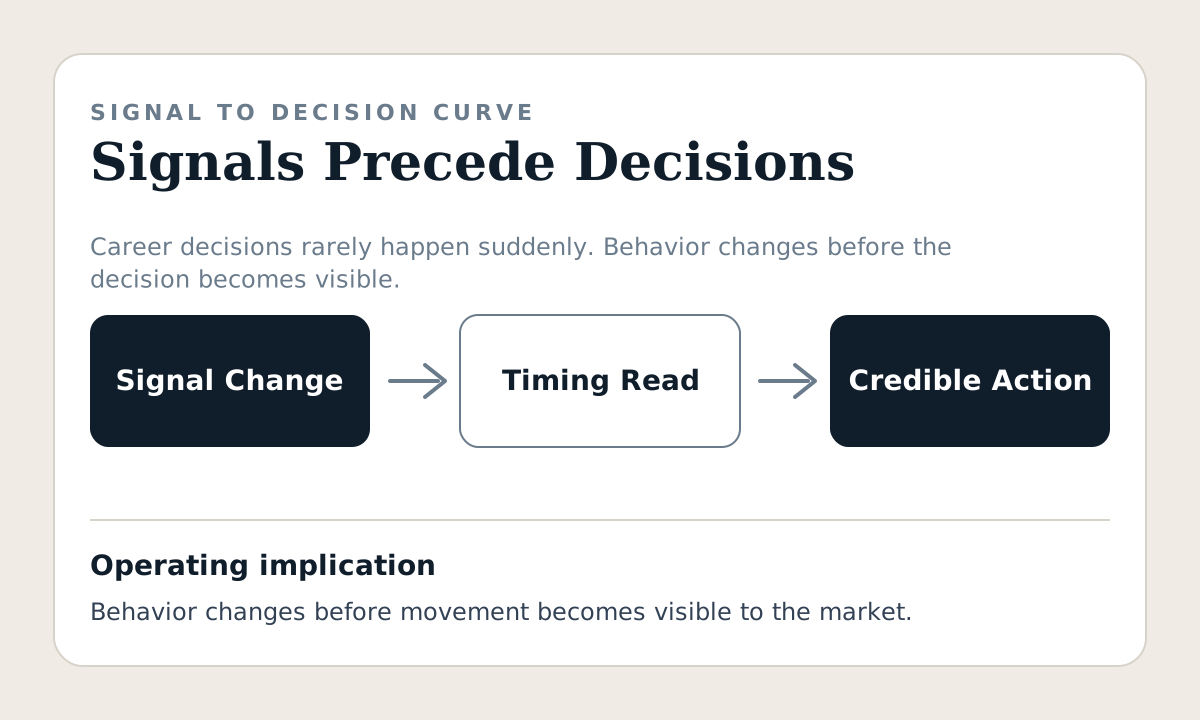
Career decisions rarely happen suddenly. Behavior changes before the decision becomes visible.
The Signal-to-Decision Curve
Signals appear before declarations. Behavior shifts before career decisions are publicly visible. The recruiting advantage is recognizing pattern change without pretending it proves intent.
Advisor movement is usually a lagging headline
A transition announcement makes movement look sudden. Inside the advisor's world, the decision usually formed over time. Something became harder to tolerate, easier to imagine, or newly possible.
The visible move is the end of a curve, not the beginning. Before it, there may have been changes in network behavior, platform frustration, client-segment pressure, succession thinking, leadership trust, team dynamics, or professional curiosity.
Recruiting teams that wait until the decision is obvious are often entering a conversation that someone else prepared for earlier.
The discipline is interpretation, not prediction theater
Signals should not be treated as prophecy. A job change in a branch, a regulatory event, a public quote, a new specialization, or a shift in local leadership does not prove an advisor is ready to move.
The discipline is interpretation. What changed? Why might it matter? What else would need to be true? What is the respectful next action? A serious recruiting system should help the team ask better questions rather than make overconfident claims.
This is where experienced recruiters have always had an advantage. They know the difference between noise and a pattern worth watching. The opportunity is to make that pattern recognition more institutional.
Why timing is under-managed
Firms often manage who they want more carefully than when the conversation should happen. They build lists, rank advisors, assign territories, and set outreach goals, but timing remains informal.
Timing deserves its own operating discipline. An advisor can be a perfect strategic fit and still be unreachable at the wrong moment. Another advisor may be a moderate fit but newly open because a specific constraint changed.
The best teams do not confuse persistent outreach with good timing. They understand that patience, preparation, and signal awareness can create a better conversation than volume.
What changes in the field
When signals are managed well, recruiters show up differently. They do not open with generic platform claims. They open with context. They understand why the conversation might matter now and where uncertainty remains.
That kind of preparation is felt by advisors. It signals respect. It also prevents the firm from burning credibility by treating every advisor as if the same message, same sequence, and same urgency apply.
Signals precede decisions, but trust determines whether the signal becomes a conversation.
Where this breaks in the real organization
The failure mode is waiting for proof so long that the opportunity becomes obvious to everyone. Firms want certainty before investing attention, but advisor movement rarely announces itself with certainty. The better posture is disciplined curiosity: notice change, ask better questions, and prepare without pretending the signal is a decision.
The break usually shows up as normal-looking behavior. Recruiters are active. Managers are reviewing pipelines. Leaders are discussing growth. The problem is that the organization cannot prove the activity is preserving the strategy, improving judgment, or compounding knowledge.
This is why Signals Precede Decisions is not merely a phrase. It is a diagnostic lens. It helps executives see the operating problem underneath familiar recruiting symptoms.
How executives should use this
Leadership should use this framework to separate watchlist discipline from active pursuit. Some relationships deserve quiet monitoring. Some deserve research. Some deserve a warm relationship touch. Some deserve direct engagement. The framework prevents teams from treating every signal like an emergency or ignoring signals because they are not definitive.
The goal is not to create another meeting artifact. The goal is to change what the organization pays attention to. A useful framework changes the questions leaders ask, the evidence managers inspect, and the standards recruiters use before they act.
When used well, this framework should make HNTR AI feel like the natural software expression of a deeper operating philosophy: recruiting strategy should become visible, executable, measurable, and continuously improving.
The boardroom test
The boardroom test is whether a senior team can use this framework to change resource allocation, operating cadence, and management behavior. If the framework only produces agreement, it is not finished. It has to sharpen decisions: what to fund, what to measure, what to stop tolerating, and what the organization must remember.
For Signals Precede Decisions, the test is whether leaders can move from an appealing idea to an accountable operating standard. The firm should be able to say how the framework changes recruiting priorities, manager inspection, recruiter preparation, technology requirements, and the way outcomes are reviewed. If it cannot, the idea has not yet become operational.
What changes after adoption
After adoption, the conversation should sound different. Leaders should stop accepting vague pipeline updates when the real question is execution quality. Managers should stop treating stale context as a personal inconvenience and start treating it as organizational risk. Recruiters should not have to rebuild the case for every important relationship from memory.
The framework should also change technology requirements. The firm should not ask only whether a system stores data or produces activity reports. It should ask whether the system preserves context, improves judgment, coordinates the next action, and helps the organization learn from what happened.
The operating standard is not clever language, but a better way to run advisor recruiting. If an executive reads the framework and cannot identify one operating assumption worth changing, the framework has not done enough work. The idea should leave the room with a management consequence, a clearer standard for leadership behavior, and a practical next question for the team to answer in its next operating review.
Field notes
- The goal is not to predict human beings with false precision. The goal is to notice change early enough to prepare intelligently.
- Timing is often the variable firms discuss least and blame most after losing.
- A signal should create a better question before it creates a stronger action.
Why it matters
By the time movement is obvious, the conversation is crowded. Early signal recognition lets firms prepare with more credibility and patience.
Common misconceptions
- That timing is luck.
- That one signal proves intent.
- That public data alone explains advisor movement.
Practical implications
- Recruiting teams should treat timing as a variable that can be studied.
- Signals should create better questions, not false certainty.
- Preparation should begin before an advisor is actively shopping.
Questions executives should ask
- Which signals change our view of timing?
- How do we distinguish evidence from interpretation?
- Do we prepare before the market sees the decision forming?