Overview
Recruiters leave, managers change, CRM notes become stale, conversations disappear, and relationships restart. Organizations that preserve institutional memory consistently make better future decisions.
Core idea
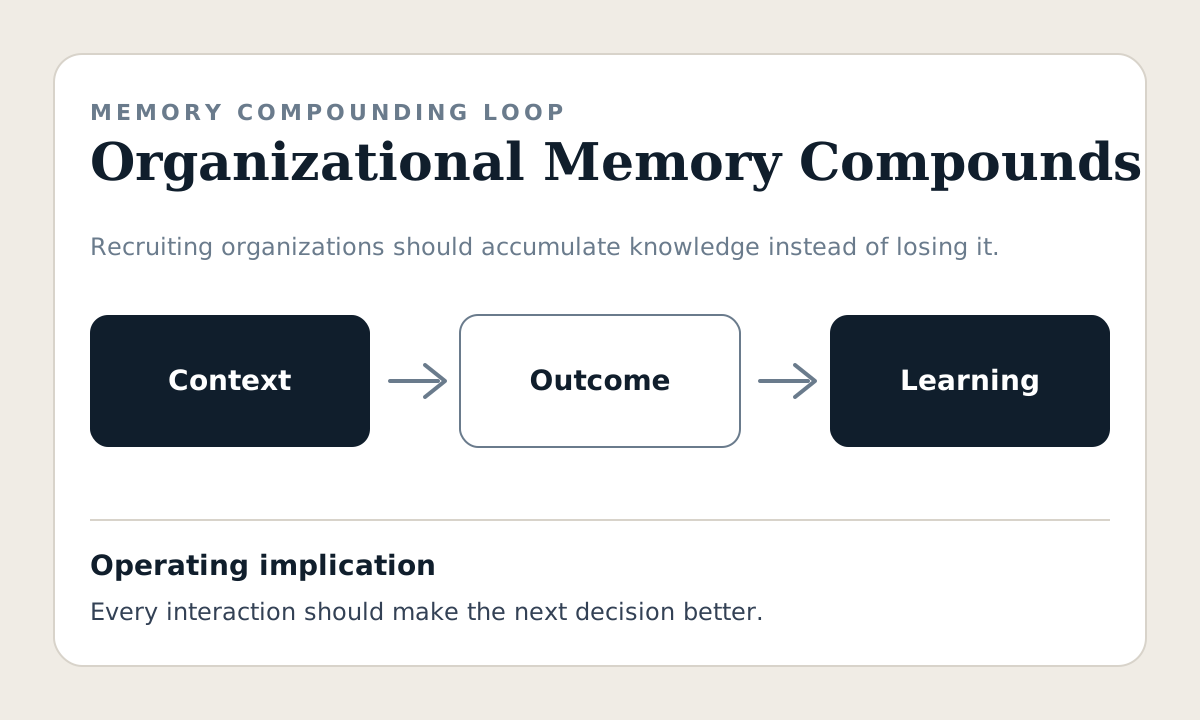
Recruiting organizations should accumulate knowledge instead of losing it.
Memorable language
- Memory compounds just like experience.
The Memory Compounding Loop
Every interaction should create reusable context. Context should improve the next action. Outcomes should improve future judgment. That loop is how recruiting organizations compound experience.
The quiet leak in recruiting organizations
Recruiting organizations leak knowledge constantly. A recruiter leaves. A manager changes markets. A note is entered without context. A relationship goes dormant. A prior objection is forgotten. A leadership introduction is repeated awkwardly because nobody remembers it happened.
None of these moments looks catastrophic alone. Together, they create a firm that keeps paying to relearn what it already knew.
This is one of the least measured costs in advisor recruiting: the cost of organizational forgetting.
Why notes are not memory
A note is a record. Memory is usable context. A note may say that an advisor declined a meeting. Memory explains why, what else was happening, who had credibility, what timing factor mattered, and what should change before the next touch.
Most CRMs are full of notes that do not help the next person make a better decision. They document that work occurred without preserving the judgment behind the work.
The difference matters because advisor recruiting relationships often unfold over long arcs. A weak memory system forces every new interaction to carry the burden of reconstructing the past.
Memory as a leadership asset
When memory compounds, leadership can see patterns that individual recruiters cannot see alone. Which objections repeat by segment? Which fit assumptions are wrong? Which markets require more patience? Which messages create trust and which create resistance?
That knowledge should not belong only to the person closest to the relationship. It should become part of the firm's institutional intelligence while still respecting human ownership and relationship nuance.
This is how recruiting organizations get smarter instead of merely busier.
The practical standard
A serious recruiting system should preserve relationship context, fit rationale, timing signals, prior objections, message history, leadership touchpoints, and outcome learning. It should also make clear what is known versus what is inferred.
The standard is not more data entry. The standard is better future judgment. If the system does not help the next recruiter, manager, or executive understand the relationship more clearly, it has not created memory.
Memory compounds just like experience because memory is how experience survives beyond the individual.
Where this breaks in the real organization
The failure mode is believing the organization remembers because the CRM contains notes. Notes without context do not compound. They become stale fragments. The next person can see that something happened but cannot understand why it mattered, what the team learned, or how the next action should change.
The break usually shows up as normal-looking behavior. Recruiters are active. Managers are reviewing pipelines. Leaders are discussing growth. The problem is that the organization cannot prove the activity is preserving the strategy, improving judgment, or compounding knowledge.
This is why Organizational Memory Compounds is not merely a phrase. It is a diagnostic lens. It helps executives see the operating problem underneath familiar recruiting symptoms.
How executives should use this
Executives should use this framework after any handoff, reorganization, or recruiting leadership change. Ask what knowledge would disappear if the current relationship owner left tomorrow. Then ask whether the next person could continue the relationship with credibility. If the answer is no, the firm is not preserving institutional memory.
The goal is not to create another meeting artifact. The goal is to change what the organization pays attention to. A useful framework changes the questions leaders ask, the evidence managers inspect, and the standards recruiters use before they act.
When used well, this framework should make HNTR AI feel like the natural software expression of a deeper operating philosophy: recruiting strategy should become visible, executable, measurable, and continuously improving.
The boardroom test
The boardroom test is whether a senior team can use this framework to change resource allocation, operating cadence, and management behavior. If the framework only produces agreement, it is not finished. It has to sharpen decisions: what to fund, what to measure, what to stop tolerating, and what the organization must remember.
For Organizational Memory Compounds, the test is whether leaders can move from an appealing idea to an accountable operating standard. The firm should be able to say how the framework changes recruiting priorities, manager inspection, recruiter preparation, technology requirements, and the way outcomes are reviewed. If it cannot, the idea has not yet become operational.
What changes after adoption
After adoption, the conversation should sound different. Leaders should stop accepting vague pipeline updates when the real question is execution quality. Managers should stop treating stale context as a personal inconvenience and start treating it as organizational risk. Recruiters should not have to rebuild the case for every important relationship from memory.
The framework should also change technology requirements. The firm should not ask only whether a system stores data or produces activity reports. It should ask whether the system preserves context, improves judgment, coordinates the next action, and helps the organization learn from what happened.
The operating standard is not clever language, but a better way to run advisor recruiting. If an executive reads the framework and cannot identify one operating assumption worth changing, the framework has not done enough work. The idea should leave the room with a management consequence, a clearer standard for leadership behavior, and a practical next question for the team to answer in its next operating review.
Field notes
- A recruiting organization that forgets cannot become excellent; it can only become active.
- The best relationship context is often the first thing lost in a handoff.
- If the next action does not benefit from the last interaction, the system is not learning.
Why it matters
Recruiting advantage compounds when the organization remembers context, objections, timing signals, fit assumptions, and outcomes across people and time.
Common misconceptions
- That notes equal memory.
- That relationship history belongs only to the individual recruiter.
- That a stale CRM record is harmless.
Practical implications
- Systems should preserve why a relationship mattered, not just what happened.
- Outcome learning should improve future judgment.
- Leadership should protect institutional knowledge as a strategic asset.
Questions executives should ask
- What do we forget when a recruiter leaves?
- Can we reconstruct why an advisor was prioritized six months ago?
- Does every interaction make the organization smarter?