Overview
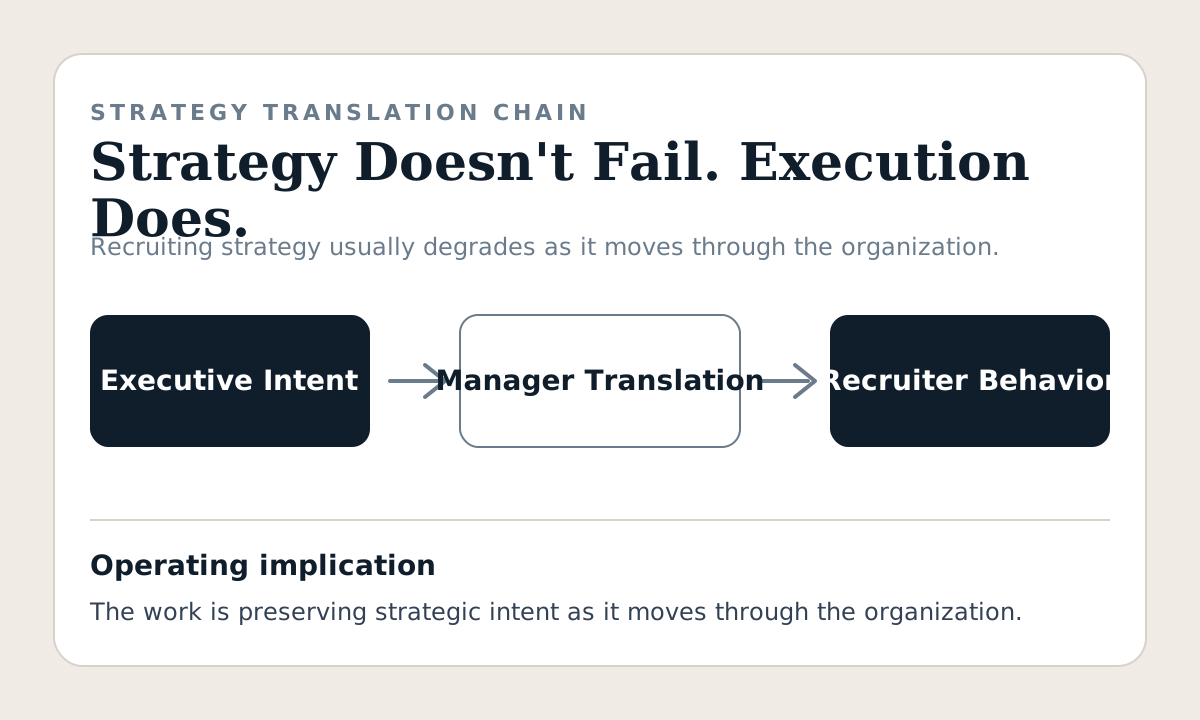
Executive vision becomes regional interpretation. Regional interpretation becomes manager preference. Manager preference becomes recruiter habit. The strategy may be sound, but execution becomes inconsistent.
Core idea
Recruiting strategy usually degrades as it moves through the organization.
The Strategy Translation Chain
Executive vision becomes regional interpretation. Regional interpretation becomes manager preference. Manager preference becomes recruiter habit. Every handoff can either preserve strategy or distort it.
The first failure is usually invisible
Recruiting leaders often look for failure at the point of outreach: the email was weak, the call was mistimed, the advisor was not ready, the recruiter did not follow up. Those failures matter, but they are often downstream symptoms.
The first failure usually happens earlier, when the strategy is translated from executive intent into field behavior. A leadership team may define a market priority with precision. By the time it reaches the desk, it may have become a general encouragement to make more calls in that geography.
That is not laziness. It is translation loss. The organization lacks a mechanism to preserve strategic intent as it moves across layers.
How good strategy becomes uneven behavior
Regional leaders add their own interpretation because they know local realities. Managers add preferences because they know their teams. Recruiters add habits because habits are how experienced people survive complexity. Each layer is rational. Together, they can quietly turn one strategy into six different operating versions.
One region emphasizes breakaway teams. Another emphasizes wirehouse producers. One manager pushes events. Another pushes direct outreach. One recruiter spends months warming a relationship. Another logs the name as inactive after two unanswered emails.
The executive team may believe it is running one strategy. The field may actually be running several.
Why technology often misses the point
Most systems record the activity that happens after the drift has already occurred. They can show that calls were made or meetings were held, but they cannot show whether the work still reflects the original strategy.
That is why activity reporting can create false comfort. A busy recruiting organization can still be strategically inconsistent. The better question is not whether people are working. The better question is whether the right work is happening for the right reasons with the right context.
Technology should make execution variability visible. It should show where priorities are being followed, where they are being reinterpreted, and where the organization is learning or repeating itself.
The management implication
Managers need more than pipeline inspection. They need execution inspection. Which relationships moved because timing changed? Which stalled because fit was misunderstood? Which follow-up failed because context was lost? Which recruiter is over-relying on familiar names instead of strategic priorities?
This changes coaching. The manager stops asking only, 'What happened?' and starts asking, 'What did we learn, and does the next action still match the strategy?'
That is the practical difference between supervising activity and managing execution.
Where this breaks in the real organization
The failure mode is mistaking agreement for alignment. Everyone agrees on the strategy in the meeting, but each layer of the organization leaves with a slightly different interpretation of what should happen next. By the time the work reaches the recruiter, the original strategic intent has become a local habit with a corporate label.
The break usually shows up as normal-looking behavior. Recruiters are active. Managers are reviewing pipelines. Leaders are discussing growth. The problem is that the organization cannot prove the activity is preserving the strategy, improving judgment, or compounding knowledge.
This is why Strategy Doesn't Fail. Execution Does. is not merely a phrase. It is a diagnostic lens. It helps executives see the operating problem underneath familiar recruiting symptoms.
How executives should use this
Executives should use this framework in pipeline reviews. Instead of asking only what happened, ask where the strategy changed as it moved through the organization. Which priority became vague? Which region interpreted the target differently? Which manager is coaching toward activity instead of strategic fit? Those questions reveal the execution system.
The goal is not to create another meeting artifact. The goal is to change what the organization pays attention to. A useful framework changes the questions leaders ask, the evidence managers inspect, and the standards recruiters use before they act.
When used well, this framework should make HNTR AI feel like the natural software expression of a deeper operating philosophy: recruiting strategy should become visible, executable, measurable, and continuously improving.
The boardroom test
The boardroom test is whether a senior team can use this framework to change resource allocation, operating cadence, and management behavior. If the framework only produces agreement, it is not finished. It has to sharpen decisions: what to fund, what to measure, what to stop tolerating, and what the organization must remember.
For Strategy Doesn't Fail. Execution Does., the test is whether leaders can move from an appealing idea to an accountable operating standard. The firm should be able to say how the framework changes recruiting priorities, manager inspection, recruiter preparation, technology requirements, and the way outcomes are reviewed. If it cannot, the idea has not yet become operational.
What changes after adoption
After adoption, the conversation should sound different. Leaders should stop accepting vague pipeline updates when the real question is execution quality. Managers should stop treating stale context as a personal inconvenience and start treating it as organizational risk. Recruiters should not have to rebuild the case for every important relationship from memory.
The framework should also change technology requirements. The firm should not ask only whether a system stores data or produces activity reports. It should ask whether the system preserves context, improves judgment, coordinates the next action, and helps the organization learn from what happened.
The operating standard is not clever language, but a better way to run advisor recruiting. If an executive reads the framework and cannot identify one operating assumption worth changing, the framework has not done enough work. The idea should leave the room with a management consequence, a clearer standard for leadership behavior, and a practical next question for the team to answer in its next operating review.
Field notes
- The most dangerous strategy drift is the drift nobody notices because everyone is busy.
- A clean dashboard can still hide a broken operating model if it measures volume instead of fidelity to strategy.
- The purpose of workflow is not bureaucracy. It is to keep good strategy from dissolving into local improvisation.
Why it matters
A recruiting organization can agree on the right strategy and still lose because the operating model allows too much variation in communication, workflow, accountability, and institutional learning.
Common misconceptions
- That strategy alignment is complete once leadership approves the plan.
- That inconsistent execution is only a personnel problem.
- That recording activity is the same as managing execution quality.
Practical implications
- Technology should reduce execution variability, not simply document what happened.
- Managers need evidence of where strategy changes as it moves through the organization.
- Recruiting workflows should preserve the intent behind the strategy.
Questions executives should ask
- Where does our recruiting strategy change shape after it leaves the executive team?
- Which actions should happen consistently regardless of region or recruiter?
- Can we see the difference between activity volume and execution quality?